UX Designer and Researcher
The User
Research & Planning
-MoSCoW Method

Sonder-
AC-DC
Converter
Live project with Alpkit-Sonder
5 weeks 2024
The initial challenge in this project was identifying the right user group, as dynamo converters are a relatively niche product with no immediately obvious audience. Through desk research, I discovered that bikepackers are the primary demographic, relying on self-sufficient energy solutions during long-distance travel. With the unfamiliar context I placed strong emphasis on user research and understanding the environment to ensure the design was grounded in real user needs and behaviours rather than assumptions. Outreaching to the bikepacking community, I analysed a local bikepackers rigging to uncover the limitations with there current Dynamo setup.


I used the MoSCoW method to prioritise features, helping to distinguish what was essential for the user from what was desirable but not critical. This allowed me to balance user needs with practical constraints, while also identifying features that should be avoided to maintain a focused and feasible design.

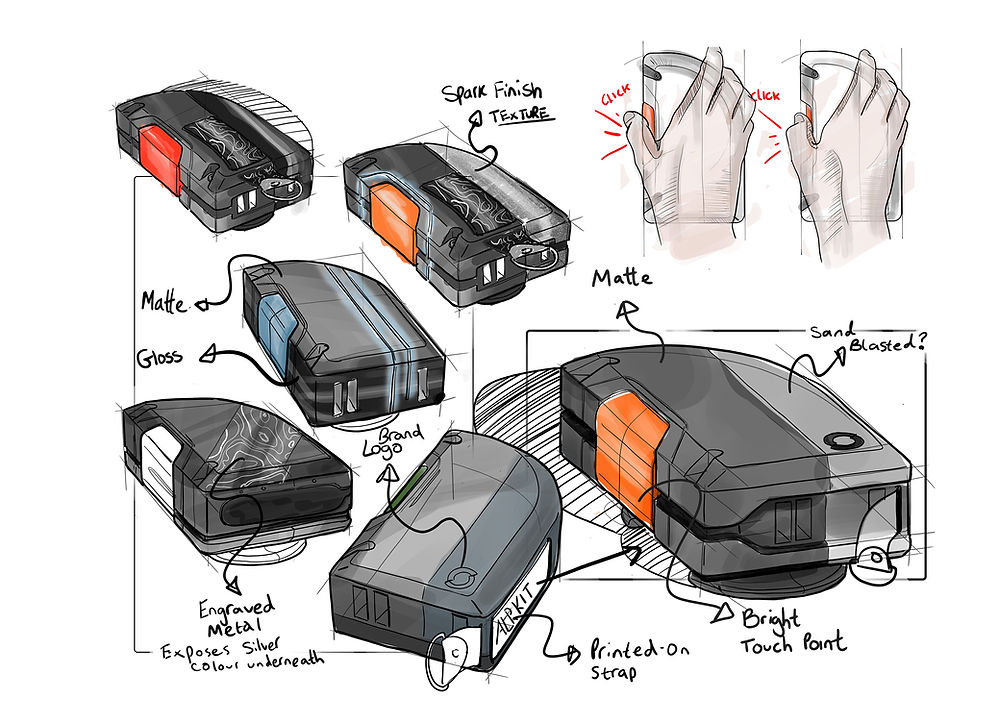
For a live project with Alpkit (Sonder), the challenge was given to design the housing for their developed AC-DC converter, a key component that interfaces with their existing dynamo product. The converter enables cyclists to efficiently charge electronic devices using pedal power, and the housing needed to be robust, weather-resistant, and seamlessly integrate with the bike's setup. This project involved close consideration of user needs, technical constraints, and Alpkit’s brand values.
Following the MoSCoW prioritisation, the concept development phase focused on translating key user needs into practical design decisions. By iterating on how users would physically interact with the product while in motion, I was able to refine the experience to reduce friction and improve usability.

Conclusion
The final concept successfully responds to key insights, particularly around wire management, compact form and ease of use within a moving environment. By simplifying cable organisation and integrating a space-efficient design, the product supports the needs of bikepackers who rely on efficient, unobtrusive systems during long journeys.
Reflecting on the outcome, one area for further development would be improving interaction accessibility. Introducing a wireless control interface, such as a wearable or handlebar-mounted switch, would allow users to redirect energy flow more intuitively without needing to access the main unit on the bike frame. This would further reduce friction and enhance usability.